Is Your Business Ready for Google Ads? 4 Essentials Before You Invest
Paid search can capture demand. It cannot repair the parts of the business that happen before and after the click.
Google Ads is often treated as a simple formula: launch campaigns, generate leads, and expect revenue. In practice, paid media is one part of a larger system. Strong targeting and bidding cannot fix weak economics, slow lead response, or unclear revenue attribution.
That is why the most responsible recommendation is not always to launch immediately. Sometimes the right next step is to strengthen the business around the campaign first.
| The better question: Can this business turn paid demand into profitable, measurable outcomes? |
Four conditions to check before launch
These are not campaign settings. They are business conditions that determine whether the traffic Google Ads generates can become profitable revenue. Before assigning budget, confirm that each area is visible enough to manage and strong enough to support a meaningful test:
- Demand: Qualified prospects are actively searching for the offer in the locations the business can serve. If volume is limited or most searches indicate research rather than purchase intent, campaign optimization alone cannot create enough opportunity.
- Economics: Your close rate, gross margin, and customer value can support the expected acquisition cost. The target cost per acquisition (CPA) should come from what a qualified lead and closed customer are worth, not from a generic industry benchmark.
- Follow-up: Every inquiry has an owner, a response-time expectation, and a visible status in a lead log or customer relationship management (CRM) system. Slow or inconsistent follow-up can make a valid opportunity look like a poor-quality lead.
- Measurement: The business can connect ad activity to qualified opportunities and recognized revenue. This requires shared definitions for a lead, a qualified opportunity, and a sale, plus a way to pass those outcomes back into reporting.
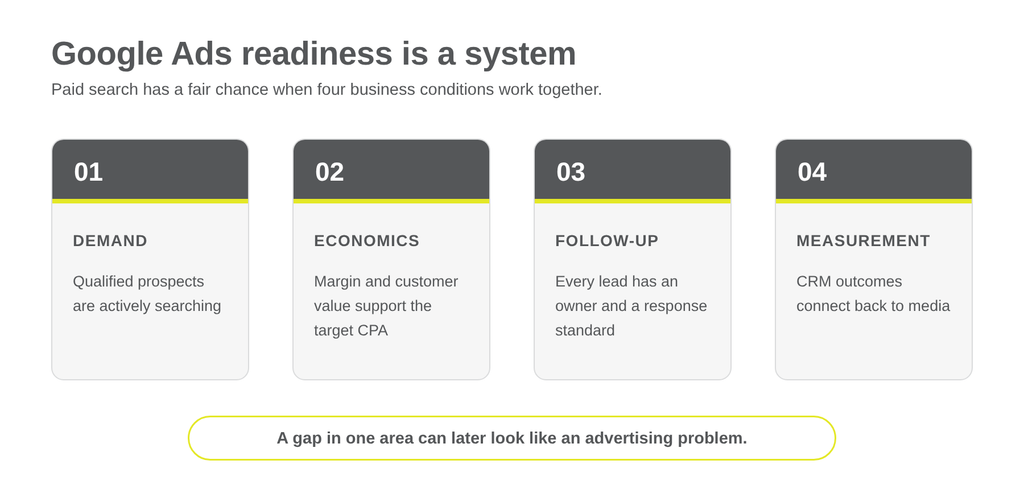
Figure 1. Four connected conditions give paid search a fair chance to succeed.
These conditions do not need to be perfect before launch, but they do need to be visible and actively managed. If one area is weak, the first phase may be a readiness sprint: validate demand, model the economics, define the follow-up process, and align reporting. Without that groundwork, a campaign may generate valid leads while revenue remains invisible, making a business-system gap look like a Google Ads problem.
AI can advise, but expertise, business knowledge, and context decide
AI can accelerate analysis, challenge assumptions, and surface patterns a team may have missed. But a reliable recommendation about whether to launch, continue, or pause Google Ads should draw on three inputs. Each one answers a different question, and none can substitute for the others.
- Paid media expertise: This interprets what is happening inside the account and separates a real performance problem from a tracking issue or normal platform behavior. A sound review should distinguish primary conversions from secondary actions, understand the signals bidding relies on, evaluate search terms and geographic intent, and account for recent changes or learning periods.
- Business knowledge: This determines whether the campaign outcome is commercially viable. Margins, customer value, close rate, sales cycle, service capacity, and lead follow-up all change what good performance looks like. A high CPA may be sustainable for a high-value offer, while a low cost per lead may still be wasteful if the inquiries are unqualified or never followed up.
- Decision context: This places the evidence in the right situation and time frame. The original goals, date range, seasonality, budget changes, account-change timeline, conversion definitions, CRM outcomes, and data limitations all matter. If AI receives only a snapshot, a few metrics, or a frustrated summary, its answer will reflect that incomplete frame.
When one input is missing, the recommendation becomes biased toward the limited evidence AI can see. Paid media expertise without business knowledge may optimize the wrong outcome. Business knowledge without paid media expertise may misread normal advertising behavior. Context without either can produce a well-organized but unreliable conclusion.
| Practical rule: Use AI to challenge the diagnosis, not to replace it. Final decisions should combine all three: paid media expertise, business knowledge, and complete decision context. |
Plan for the attribution gap
The ad platform, analytics tools, CRM, and revenue records observe different parts of the customer journey, so they rarely report the same number.
Before launch, agree on what counts as a lead, a qualified opportunity, and a sale. Then define which system answers each question. The platform helps explain media contribution. The CRM explains what happened after the inquiry. Revenue records confirm the business outcome.
Launch, prepare, or pause
Once the four readiness conditions have been reviewed, the recommendation should fall into one of three paths. This avoids turning the conversation into a false choice between launching immediately and rejecting paid search entirely.
- Launch: Demand, economics, follow-up, and measurement are strong enough to support a structured test. Launch does not mean committing to scale on day one. It means starting with a defined budget, success criteria, a reasonable learning period, and scheduled review points.
- Prepare: The opportunity appears viable, but one or more supporting systems need work first. This may include improving the offer or landing page, defining CRM stages, validating tracking, setting response-time standards, or confirming service capacity. Paid search can begin after the main constraint has an owner and a plan.
- Pause: Evidence suggests paid search is not the best near-term investment. Search demand may be too limited, the acquisition economics may be unsustainable, the offer may be unclear, or the business may be unable to serve additional demand. A pause should identify what would need to change before the channel is reconsidered and where the budget may work better in the meantime.
These paths are not permanent labels. A business can move from prepare to launch once the gaps are addressed, or from launch to pause if the economics fail after a fair test. The goal is a decision with clear conditions, not a blanket verdict on Google Ads.
Even in the launch path, paid search is not a magic button, and results are rarely instant. Campaigns need enough time and conversion volume to learn, plus ongoing testing of queries, bidding, messaging, landing-page experience, and lead quality. A readiness check does not make the strategy more cautious. It makes expectations clearer, responsibilities explicit, and the investment more accountable.
Considering paid social instead? Meta’s AI now decides who sees your ads based on your creative, not your targeting settings. In our free 25-minute webinar, Paid Social Strategist Grace Glass explains what changed and how to make your ad budget work harder. Watch the free webinar →
A stronger starting point
At Optidge, we look beyond the ad account to understand how paid media connects to the full funnel. That means aligning campaign strategy with business economics, lead handling, CRM visibility, and the way revenue is measured.
If those foundations are ready, Google Ads can become a powerful growth channel. If they are not, the smartest first move may be to build them.
| Planning a paid search investment? Start with a readiness conversation that connects media decisions to the way your business actually creates revenue. |